
Questions
Everything People Ask Us Before They Start.
Twenty-three of them, grouped. Most were asked on a real discovery call. If yours isn't here, call or text (619) 397-1391 and ask it.
Before you start
I haven't had my injections yet. Is it too early to talk to you?
No — it's the best time. Clients who set the plan up before the procedure know what the first two weeks look like before they're in them, and they don't lose the fortnight afterwards working out who to ask.
I had my injections eight months ago. Is it too late?
Usually not. Tissue can keep remodelling for six to twelve months, and the strength work that protects the joint has no expiry date at all. What changes is where we start, not whether we can.
Do you perform the stem cell injections?
No. We handle everything that happens after them. Wherever you had yours — down the street or in another country — the recovery is the part we do.
Do I have to have had my procedure at a particular clinic?
No. Our clients come to us from clinics all over the world — and from every kind of procedure, from a straight IV to local injections to both. We work as a third party: we look at what the research says across the whole field and build the recovery around whatever protocol you were given.
Is there a way to hear you before I commit to anything?
Yes — Dr. Chris runs a free live class most months. Ninety minutes, twenty seats, camera optional. It covers the three critical steps of recovery, how to avoid flare-ups, and what to do when you're worried about re-injury going back to exercise.
Will this replace the physical therapist I'm already seeing?
It doesn't have to. Plenty of clients keep their local therapist for hands-on work and use us for the plan — what to load, when, and what to leave alone. If you'd rather run the whole thing with us, that works too.
The recovery itself
How long does this actually take?
The written arc runs 24 weeks, in six phases. Your dates shift with your joint, your procedure and what you're training for — the order doesn't.
I'm six weeks in and I don't feel different. Has it failed?
Almost certainly not. Six weeks is early. Most people are still in the healing phase, and the change clients notice first is rarely dramatic — it's stairs, or getting out of a chair, or the first steps in the morning.
I had a flare-up. Did I damage something?
Flare-ups are information about load, not evidence the injection didn't take. Handled properly, one costs you a few days. Handled as a failure, it costs weeks — because people stop moving entirely.
Why can't I just rest until it stops hurting?
Because tissue remodels along the lines of the stress you put through it. Rest protects the site, which matters early, but it doesn't give the repair a direction — and the muscle you lose in the first eight weeks is the muscle that keeps load off the joint for the next twenty years.
My MRI looks the same. Does that mean it didn't work?
Not by itself. Imaging and symptoms often move on different timelines, and function can improve well before a scan changes.
When can I run again?
Running sits late in the arc — usually the strength phase at the earliest, and it's a walk-run progression before it's a run. Rushing this is the single most common way a good procedure gets wasted.
Can I keep training while I recover?
In most phases, yes — just not the same training. Every movement sits in one of three lanes: green, amber or red. You always know which lane you're in this week.
Working with us
How does the virtual program actually work?
A written program built for your joint and your procedure, delivered phase by phase, with video coaching and a scheduled check-in. Your program is reviewed and changed as you clear milestones, not on a fixed calendar.
I'm not very technical. Is that a problem?
No. If you can join a video call and open an email, you have everything you need. Several of our clients told us they were nervous about the virtual format before they started and stopped noticing it after the first session.
What's the difference between the virtual program and Cellular Boost?
Cellular Boost is the virtual program plus hands-on regenerative therapy in our Chula Vista or Kearny Mesa clinic — shockwave and EMTT, with hyperbaric oxygen as an add-on. It's for people in or near San Diego County.
Do I need a gym?
No. Programs are written around what you actually have. If you have a gym we'll use it; if you have a step and a band, we'll use those.
What if I travel, or I'm outside the US?
The program travels with you. We work with clients across the country and internationally.
What if I have a setback, or unrelated surgery?
We adjust the plan around it and pick the arc back up. One of our clients had an unavoidable surgery mid-program; we prepared her for it and got her back on track afterwards.
Practical
What does it cost?
It depends on which track you're on and how long you want support for. Ask on the contact form or on a call and you'll get a straight number, not a range that moves later.
Do you take insurance?
We don't bill insurance for you. That's what lets us build a six-month program around your procedure rather than around what a plan will authorise.
Where are you?
Sports Performance Physical Therapy, 861 Harold Place, Unit 307, Chula Vista, CA 91914, and our Kearny Mesa location. The virtual program runs from anywhere.
How do I start?
Three doors, in order of commitment. Read the free report — it arrives by email, nothing to log into. Come to the free live class and listen. Or take the Recovery Score assessment and ask us what it costs. Any of the three puts a real person in touch with you.
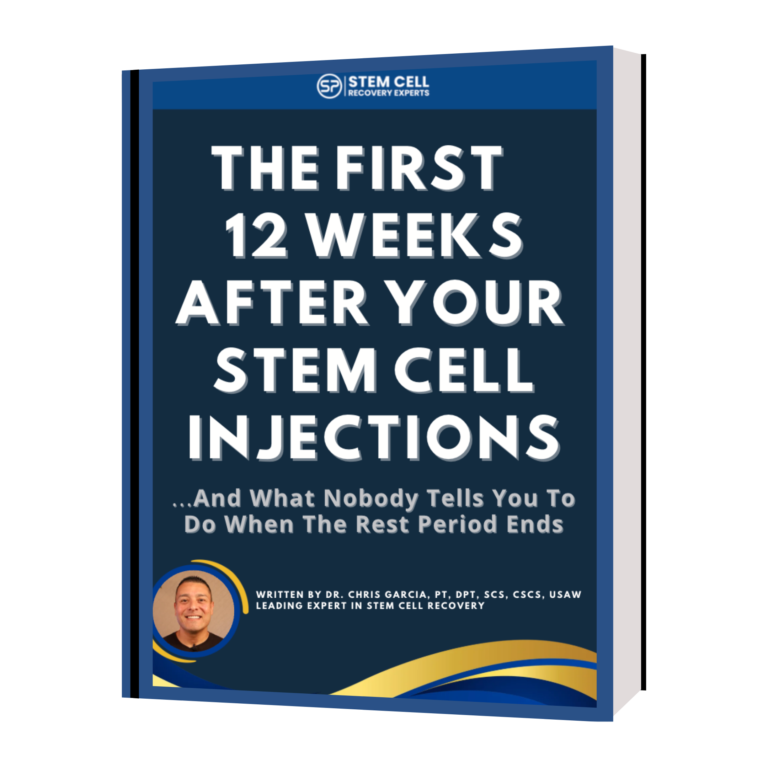
Free report
Before your next appointment, read page 6
Most people leave the clinic with a rest period and a date to come back. Nobody tells them what they are cleared to do in between — so they either sit still for twelve weeks or go straight back to the old routine and pay for it.
Page 6 is the green, amber and red clearance page. What you can do right now, what waits, and what to stop. Fifteen pages, and it costs nothing.